How to Calculate IRR on a Rental Property (With Example)
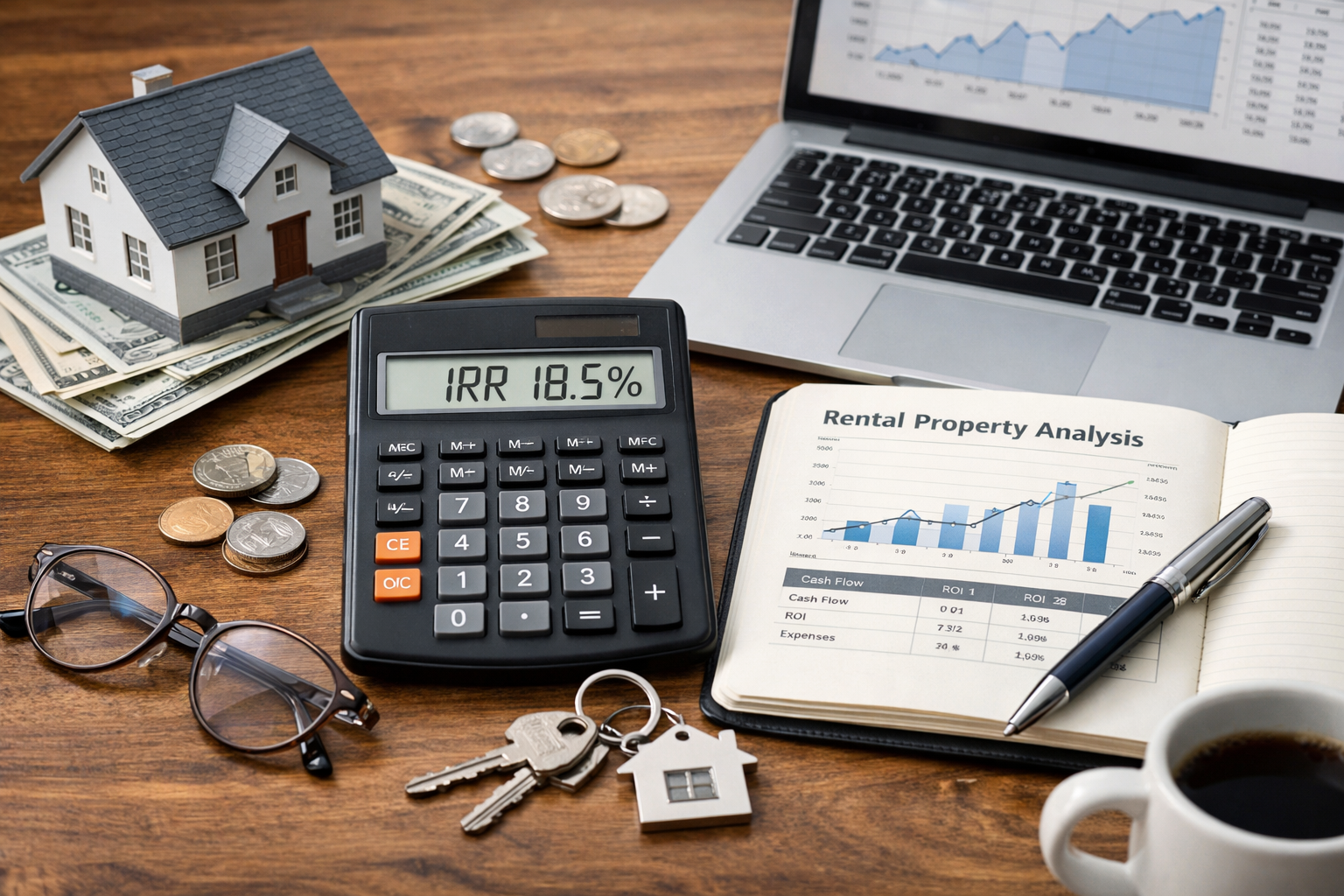
How to calculate IRR on a rental property
To calculate IRR on a rental property, you list every cash flow the deal produces — your upfront cash invested (a negative number), each year of annual cash flow, and the net proceeds when you sell — then solve for the discount rate that makes the present value of all those cash flows equal to zero. That rate is your internal rate of return (IRR). In practice you don't solve it by hand; you use the IRR or XIRR function in a spreadsheet or an analysis tool that models the full hold.
IRR matters because it's the one return metric that accounts for both timing and total return. Cash-on-cash tells you about year one. Cap rate ignores financing and appreciation entirely. IRR captures cash flow, principal paydown, appreciation, and the eventual sale — and it penalizes returns that arrive later. That makes it the closest thing to how institutional buyers actually compare deals.
What IRR actually measures
Think of IRR as the annualized, compounding rate of return on the money you have tied up in the deal, for as long as it's tied up. A 15% IRR means your invested capital effectively grew at 15% per year across the hold, once you account for when every dollar came in and went out.
Three inputs drive it:
- Initial equity outlay — down payment, closing costs, and any rehab you fund out of pocket.
- Annual after-debt cash flow — NOI minus your mortgage payment, year by year. If you're shaky on the operating side, review how to calculate rental property cash flow first.
- Net sale proceeds — projected sale price minus selling costs and remaining loan balance in your exit year.
The IRR formula, in plain English
The textbook formula sets net present value to zero:
0 = CF0 + CF1/(1+IRR) + CF2/(1+IRR)² + ... + CFn/(1+IRR)ⁿ
Where CF0 is your initial investment (negative) and CF1 through CFn are the cash flows in each year, with the final year including your sale proceeds. There's no clean algebraic solution — the software iterates until it finds the rate that balances the equation. Your job isn't the math; it's feeding it honest, well-researched numbers.
A worked 5-year example
Take a $250,000 single-family rental with 25% down:
- Purchase price: $250,000
- Down payment (25%): $62,500
- Closing costs: $6,000
- Initial cash invested (Year 0): -$68,500
Assume it produces $4,800 in after-debt cash flow in Year 1, growing modestly as rents outpace expenses:
- Year 1: +$4,800
- Year 2: +$5,100
- Year 3: +$5,400
- Year 4: +$5,700
- Year 5: +$6,000 (plus sale)
Now the exit. Assume 3% annual appreciation, so the property is worth roughly $289,800 in Year 5. Subtract 7% selling costs ($20,300) and the remaining loan balance (~$172,000 after five years of paydown on the ~$187,500 loan). Net sale proceeds land near $97,500.
So Year 5's total cash flow is $6,000 + $97,500 = +$103,500.
Drop this stream into =IRR():
-68,500 | 4,800 | 5,100 | 5,400 | 5,700 | 103,500
The IRR comes out to roughly 14.5%. Notice how much of that return lives in the exit year — principal paydown and appreciation, not cash flow. That's the point IRR makes that other metrics miss, and it's the core of total-return thinking for buy-and-hold.
Use XIRR when dates aren't annual
IRR assumes evenly spaced periods. If you buy mid-year, refinance, or fund rehab in irregular chunks (common on BRRRR deals), use XIRR and pair each cash flow with its actual date. It handles uneven timing correctly — and timing is exactly what IRR is sensitive to.
What's a good IRR on a rental?
There's no universal number, but general benchmarks help:
- 8–12% — typical for a stabilized, lower-risk buy-and-hold in a strong market.
- 12–18% — a solid leveraged single-family or small multifamily deal.
- 18%+ — usually signals value-add, BRRRR, or aggressive appreciation assumptions that deserve extra scrutiny.
Always ask where the IRR comes from. A 20% IRR built on a 5% appreciation assumption is far more fragile than a 13% IRR built mostly on cash flow and paydown.
The mistakes that quietly inflate IRR
IRR is powerful and easy to game. Watch for these:
- Optimistic appreciation. Because so much return sits in the exit, a half-point bump in appreciation can swing IRR by several points. Anchor your rate to market history, not hope — see what appreciation rate to use.
- Ignoring selling costs. Agent commissions, transfer taxes, and concessions can eat 6–8% of the sale. Leaving them out flatters the exit.
- Forgetting vacancy, capex, and expense growth. Thin operating assumptions inflate every year of cash flow before compounding.
- Confusing IRR with cash-on-cash. They answer different questions. IRR is a lifetime, timing-weighted rate; cash-on-cash is a single-year snapshot.
- Reinvestment assumptions. IRR implicitly assumes interim cash flows earn the same rate — rarely true. For deals with large early distributions, sanity-check against equity multiple.
Why real data beats guesswork here
IRR is only as trustworthy as its inputs — and it has more inputs than any other metric, each compounding across the hold. Guess the rent, fudge the tax growth, and eyeball appreciation, and your "14.5% IRR" is fiction. This is where analyzing the deal on live, verified numbers changes the game: tools like PropertyWiz AI pull real market value, rent, taxes, insurance, vacancy, and appreciation and model the full multi-year hold automatically, so your IRR reflects the market instead of your optimism.
Run IRR alongside cash-on-cash and cap rate, not instead of them. Together they tell you whether a deal wins on cash flow, on the exit, or — the deals worth chasing — on both.
Frequently asked questions
What's the difference between IRR and cash-on-cash return?
Cash-on-cash measures your cash flow return in a single year, while IRR measures your annualized, timing-weighted return across the entire hold — including appreciation, principal paydown, and the sale.
Do I use IRR or XIRR for a rental property?
Use IRR when cash flows are evenly spaced once per year. Use XIRR when the timing is irregular — such as a mid-year purchase, refinance, or staggered rehab funding — since it accounts for the actual dates.
What is a good IRR for a rental property?
Roughly 8–12% is typical for a stabilized low-risk hold, 12–18% for a solid leveraged deal, and 18%+ usually signals value-add or aggressive assumptions worth double-checking.
Related articles
How to Build a Rental Property Pro Forma (Line by Line)
Learn how to build a rental property pro forma line by line — from gross rent to projected returns — with real numbers, rules of thumb, and the mistakes that sink deals.
5 min readHow to Calculate Return on Equity on a Rental Property
Return on equity on a rental property equals your annual after-tax return divided by your current equity. Here's the formula, a worked example, and why it matters.
5 min readHow to Buy a Rental Property: A First Deal Walkthrough
How to buy a rental property step by step: set your criteria, run the numbers, finance the deal, and close on cash-flowing real estate with confidence.
5 min readAnalyze your next deal in seconds
PropertyWiz AI pulls live data and runs Buy & Hold, BRRRR, and Fix & Flip numbers for you.
Get started free →