The IRR Formula for Rental Deals: A Step-by-Step Guide
What Is the IRR Formula for a Rental Property?
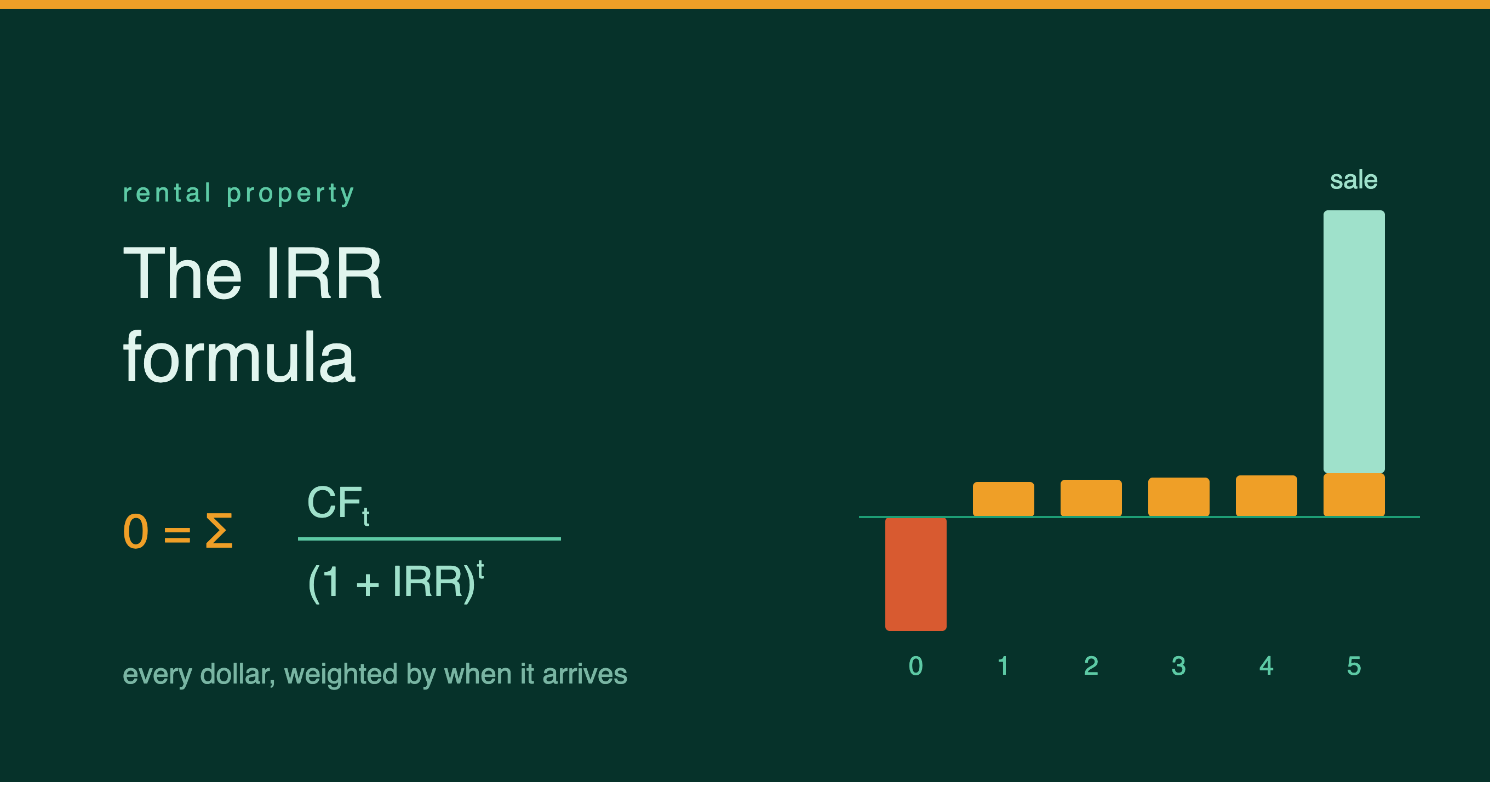
The IRR formula is the discount rate that makes the net present value (NPV) of all a deal's cash flows — the money out and the money in — equal to zero. In plain terms, internal rate of return (IRR) is the annualized percentage return your capital earns over the entire life of a hold, accounting for when every dollar arrives.
Here is the formula in its standard form:
0 = CF0 + CF1/(1+IRR)^1 + CF2/(1+IRR)^2 + ... + CFn/(1+IRR)^n
Where:
- CF0 = your initial investment (a negative number — cash going out)
- CF1 … CFn = the net cash flow in each period, including the sale proceeds in the final year
- IRR = the rate you solve for
The catch: you cannot isolate IRR algebraically. There is no clean "IRR = " version of the equation. It has to be solved by iteration — trying rates until NPV lands on zero — which is why spreadsheets and analysis tools handle it for you.
Why IRR Beats Cash-on-Cash and Cap Rate
Most investors lean on single-year snapshots. Those metrics are useful, but they ignore time.
- Cap rate tells you the unlevered yield at one moment.
- Cash-on-cash tells you your levered return in a single year.
- IRR ties together every cash flow across the full hold — acquisition, annual cash flow, refinances, and the eventual sale — into one time-weighted number.
That time weighting matters. A dollar of profit collected in year 1 is worth more than a dollar collected in year 10, because you can reinvest it sooner. IRR is the only common metric that prices that in. If you want to see how the one-year metrics stack up against each other first, the breakdown in cash-on-cash vs. cap rate is a useful primer.
How to Calculate IRR on a Rental: A Worked Example
Walk through a five-year buy-and-hold on a single-family rental.
The setup:
- Purchase price: $250,000
- Down payment + closing + light rehab: $65,000 (your CF0 = -$65,000)
- Year 1 net cash flow after debt service: $4,200
- Cash flow grows ~3%/year with rent increases
- Sale in year 5 at $310,000, netting ~$95,000 after paying off the loan balance and selling costs
The annual cash flows:
| Year | Cash Flow |
|---|---|
| 0 | -$65,000 |
| 1 | $4,200 |
| 2 | $4,326 |
| 3 | $4,456 |
| 4 | $4,590 |
| 5 | $4,727 + $95,000 sale = $99,727 |
Solving it: Drop those values into a column in Excel or Google Sheets and use =IRR(range). For this deal the IRR lands right around 13–14%.
Notice what's driving it: the $95,000 back-end proceeds dominate the return. The annual cash flow matters, but the sale price — set by your appreciation and loan paydown assumptions — is the swing factor. That's the core lesson: IRR is only as honest as your exit assumption.
Doing it by hand (the intuition)
You rarely calculate IRR manually, but understanding the iteration helps. Guess 10%: discount each cash flow, sum them, and if the NPV is positive, your true IRR is higher. Guess 15%: if NPV goes negative, the answer sits between the two. Keep narrowing until NPV hits zero. That back-and-forth is exactly what IRR() automates.
Best Practices for Using IRR
- Always define the hold period. IRR is meaningless without a timeframe. A 5-year IRR and a 10-year IRR on the same property tell very different stories.
- Use conservative exit cap rates. Assume you sell at a cap rate slightly higher than you bought at. If the numbers still work, the deal has margin.
- Include every real cash flow. Refinance proceeds, capital calls for a new roof, and leasing costs all belong in the timeline. Skipping them inflates the result.
- Pair IRR with equity multiple. IRR rewards speed; equity multiple rewards total dollars. A quick flip can post a huge IRR but a small multiple. See what equity multiple actually measures for the counterbalance.
The Pros of IRR
- Captures the full life of the deal in one figure.
- Accounts for the timing of every dollar.
- Lets you compare wildly different deals — a 3-year BRRRR against a 10-year buy-and-hold — on equal footing.
The Cons and Pitfalls to Watch
IRR is powerful, but it lies confidently when misused.
- It assumes reinvestment at the same rate. IRR quietly assumes you can redeploy every interim cash flow at the same IRR. If your deal shows 20% but you can only reinvest at 8%, your real-world result is lower. This is why some investors also look at MIRR (modified IRR), which lets you set a realistic reinvestment rate.
- Short holds distort it. Flipping a house in four months can produce an annualized IRR of 100%+ — a technically true but practically misleading number, since you can't repeat it 12 times a year.
- Garbage in, garbage out. An optimistic rent-growth or exit-price assumption can turn a mediocre deal into a great-looking one on paper. This is exactly the trap covered in why static calculators give you fake numbers.
- Multiple IRRs are possible. When cash flows flip sign more than once (say, a big capital call mid-hold), the math can produce two valid IRRs. Sanity-check anything strange.
Make Your IRR Inputs Real, Not Hopeful
The formula is fixed; your assumptions are not. The difference between a real 14% and a fantasy 22% is almost always the exit price, rent growth, and expense estimates. Ground those in actual comps, current rents, and defensible expense ratios rather than round-number guesses. Tools like PropertyWiz AI pull live market data into the model so your IRR reflects the market you're actually buying in — not the one you wish you were.
Run the IRR, then stress-test it: lower the exit price 5%, raise vacancy, add a surprise capex year. A deal whose IRR survives that pressure is a deal worth pursuing.
Frequently asked questions
What is a good IRR for a rental property?
For a stabilized buy-and-hold, many investors target a 5-year IRR of roughly 12–18%, depending on market and risk. Higher-risk value-add or flip deals should clear a higher bar to justify the added risk.
What's the difference between IRR and cash-on-cash return?
Cash-on-cash measures your return in a single year, while IRR blends every cash flow across the entire hold — including the sale — into one time-weighted annual figure.
Can you calculate IRR without a spreadsheet?
Only by trial and error, since IRR can't be isolated algebraically. In practice, use the IRR() function in Excel or Google Sheets, or an analysis tool that solves it automatically.
Related articles
How to Calculate Rental Property Cash Flow (Monthly)
Learn how to calculate rental property cash flow with a real monthly example, every expense line you must include, and the mistakes that wreck projections.
5 min readCap Rate vs Cash-on-Cash Return: When to Use Each
Cap rate vs cash-on-cash return explained: what each metric measures, when each one lies to you, and how to use both together on a rental deal.
5 min readHow to Estimate Rent for a Single-Family Rental
How to estimate rent for a property: pull 4-6 recent rental comps within a mile, adjust for beds, baths, and condition, then confirm with a 2-week market test.
5 min readAnalyze your next deal in seconds
PropertyWiz AI pulls live data and runs Buy & Hold, BRRRR, and Fix & Flip numbers for you.
Get started free →