How to Use Gross Rent Multiplier to Screen Rentals Fast
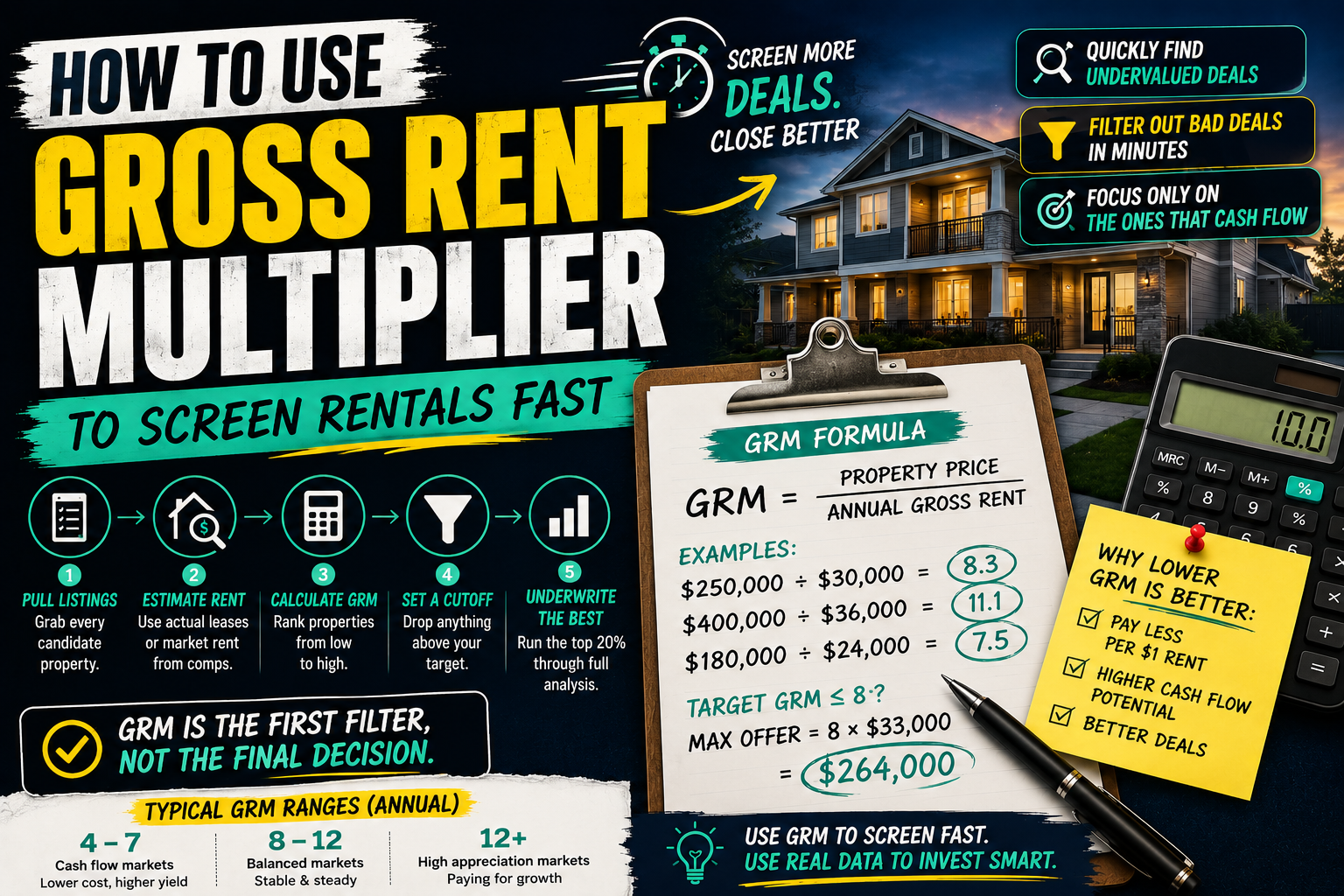
What Is Gross Rent Multiplier?
The gross rent multiplier (GRM) is a quick screening ratio that equals the property price divided by its annual gross rental income. If a property is listed at $300,000 and brings in $30,000 a year in gross rent, its GRM is 10. Lower is generally better, because it means you're paying fewer dollars per dollar of rent collected.
GRM is not a profitability metric. It ignores expenses, financing, and vacancy. What it does well is help you sort through a pile of listings in minutes and decide which ones deserve a real underwrite.
The Gross Rent Multiplier Formula
The math is intentionally simple:
GRM = Property Price ÷ Annual Gross Rent
Work a few examples so the ranges stick:
- $250,000 price ÷ $30,000 annual rent = GRM 8.3
- $400,000 price ÷ $36,000 annual rent = GRM 11.1
- $180,000 price ÷ $24,000 annual rent = GRM 7.5
You can also flip the formula to solve for a target price. If you've decided you won't buy above a GRM of 8 in a given market, and a duplex grosses $33,000 a year, your maximum offer is 8 × $33,000 = $264,000. That single line gives you a fast walk-away number before you ever pull comps.
Monthly vs. annual: don't mix them up
Some investors quote GRM using monthly rent, which produces numbers 12x smaller (a GRM of 10 on an annual basis is roughly 120 on a monthly basis). The annual version is the standard. When you compare deals, make sure every property uses the same rent period, or your rankings will be garbage.
What's a Good GRM for Small Rentals?
There is no universal "good" number, because GRM is entirely market-dependent. As a rule of thumb, though:
- GRM 4–7: Common in lower-cost, cash-flow-focused markets. Often correlates with higher yields but also older stock and softer appreciation.
- GRM 8–12: Typical of stable, balanced markets — a fair middle ground for buy-and-hold.
- GRM 12+: Common in high-appreciation coastal metros. You're paying a premium relative to rent and usually betting on price growth, not cash flow.
The only GRM that matters is the one measured against comparable properties in the same submarket. A GRM of 11 might be a screaming deal in a metro where everything trades at 14, and a terrible one where the norm is 8. Always anchor to local comps, not a national benchmark.
How to Use GRM in Your Actual Workflow
Treat GRM as the first filter in a funnel, not the decision itself.
- Pull the list. Grab every candidate property in your target zip codes.
- Estimate gross rent. Use actual leases if the property is tenant-occupied, or market rent from comparable units if it's vacant or owner-occupied.
- Compute GRM for each. Rank them low to high.
- Set a cutoff. Drop anything above your market's median GRM, or above a hard ceiling you've chosen.
- Underwrite the survivors. Run the top 20% through a full analysis with expenses, financing, vacancy, and capex.
That last step is where GRM stops and real analysis begins. A property with an attractive GRM can still lose money once you layer in high taxes, an HOA, or deferred maintenance. GRM tells you what to look at closely — it never tells you what to buy.
GRM vs. Cap Rate: Know the Difference
Investors constantly confuse these. The key distinction is expenses.
- GRM uses gross rent and ignores operating costs entirely.
- Cap rate uses net operating income — rent minus operating expenses — divided by price.
GRM is faster but blunter. Two properties with an identical GRM of 9 can have wildly different cap rates if one has $4,000 in annual taxes and the other has $11,000. Use GRM to screen, then move to cap rate and cash-on-cash to underwrite. If you want a deeper walkthrough on the next step, see the cap rate formula for small multifamily and how to think about cash-on-cash vs. cap rate when driving your buy decision.
Pros, Cons, and the Traps to Avoid
Where GRM shines
- Speed. You can rank 50 listings in the time it takes to fully underwrite one.
- Simplicity. Only two inputs, both easy to find.
- Comparability. Great for spotting mispriced properties within one submarket.
Where GRM fails you
- It hides expense monsters. High property taxes, insurance, or utilities never show up.
- It rewards inflated rent assumptions. Use a seller's optimistic "proforma" rent and your GRM will look great on a deal that doesn't exist.
- It ignores condition. A property needing $60,000 in rehab can share a GRM with a turnkey unit.
- It ignores financing entirely. Two identical GRMs can produce very different cash flow depending on your loan.
The single biggest mistake
Relying on the seller's stated rent. Always verify with actual leases, a rent roll, or independent market-rent data. If you plug in a number that's 15% too high, your GRM understates the price you're really paying, and every downstream decision inherits that error. This is the same reason static calculators quietly hand you fake numbers — bad or stale inputs produce confident, wrong outputs.
Turning GRM Into a Real Decision
GRM is the beginning of a conversation, not the end. Once a property clears your GRM screen, your job is to confirm the rent is real, model the full expense stack, and stress-test cash flow against vacancy and rate changes.
That's where working from live, verifiable data matters. Tools like PropertyWiz AI pull current rent comps and expense estimates so your GRM screen is built on defensible inputs, then carry those same numbers straight into cap rate, cash-on-cash, and long-term return projections without re-keying anything. Screen fast with GRM, then let the full underwrite decide.
Frequently asked questions
How do you calculate gross rent multiplier?
Divide the property's price by its annual gross rental income. For example, a $300,000 property earning $30,000 a year has a GRM of 10.
What is a good gross rent multiplier?
It depends on the market. GRM 4–7 is common in cash-flow markets, 8–12 in balanced ones, and 12+ in high-appreciation metros. Always compare against local comps.
Is gross rent multiplier the same as cap rate?
No. GRM uses gross rent and ignores expenses, while cap rate uses net operating income after operating costs. GRM is a screening tool; cap rate is for underwriting.
Related articles
What Is a Good Cash-on-Cash Return for Rentals?
A good cash-on-cash return for most rentals lands between 8% and 12%. Learn what drives the number, how to benchmark it, and the traps to avoid.
5 min readWhat Is the 2% Rule in Real Estate? A Cash Flow Guide
The 2% rule in real estate says a rental's monthly rent should equal at least 2% of its purchase price. Here's how it works, when it applies, and its limits.
5 min readWhat Is the 50% Rule in Real Estate? A Rental Guide
The 50% rule in real estate estimates that operating expenses eat roughly half of a rental's gross rent. Here's how to use it and where it fails.
5 min readAnalyze your next deal in seconds
PropertyWiz AI pulls live data and runs Buy & Hold, BRRRR, and Fix & Flip numbers for you.
Get started free →