The Cap Rate Formula for Small Multifamily: A Real Example
The Cap Rate Formula for Small Multifamily, Explained With Real Numbers
If you buy or list small multifamily properties, the cap rate formula is the fastest way to price a building, compare two deals side by side, and sniff out an overpriced listing before you waste time on a full underwrite. But most people apply it wrong — they plug in a seller's rosy pro forma, skip half the expenses, and end up chasing a number that doesn't exist.
This walks through the cap rate formula for a small multifamily property step by step, with a real 4-unit example, the mistakes that inflate the result, and the ranges experienced investors actually buy at.
The Formula Itself
Cap rate is simple:
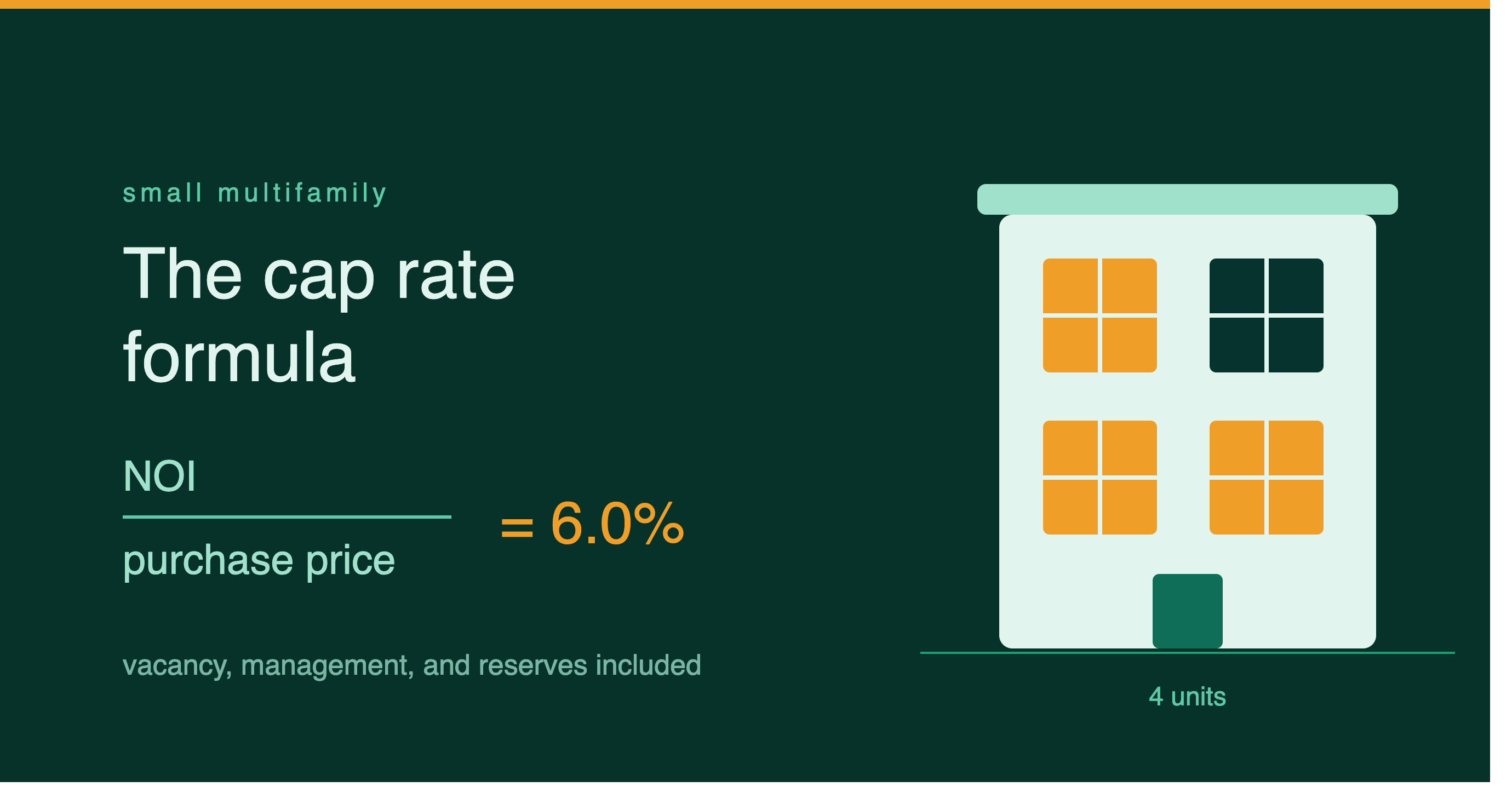
Cap Rate = Net Operating Income (NOI) ÷ Purchase Price (or Current Value)
That's it. If a building produces $24,000 of NOI and costs $400,000, the cap rate is:
$24,000 ÷ $400,000 = 6.0%
Think of it as the unleveraged annual return the property throws off if you paid all cash. It deliberately ignores financing so you can compare properties on an apples-to-apples basis, regardless of how each buyer plans to fund the deal.
The Part Everyone Gets Wrong: NOI
The formula is easy. Getting NOI right is where deals are won or lost. NOI is annual income minus annual operating expenses — and it never includes your mortgage payment, capital improvements, or depreciation.
Here's how to build it correctly for a 4-unit at four rents of $1,100/month:
Income
- Gross scheduled rent: 4 × $1,100 × 12 = $52,800
- Less vacancy (use 5–8%, not zero): –$3,168 at 6%
- Effective gross income: $49,632
Operating expenses (annual)
- Property taxes: $6,500
- Insurance: $2,400
- Property management (8–10% of collected rent): $3,970
- Repairs & maintenance: $2,600
- Water/sewer/trash (owner-paid on many small multis): $3,200
- CapEx reserves (roof, HVAC, turns): $2,600
- Lawn/snow/common electric: $1,200
- Total operating expenses: $22,470
NOI = $49,632 – $22,470 = $27,162
At a $450,000 price, the real cap rate is $27,162 ÷ $450,000 = 6.0% — not the 8%+ the listing brochure claimed by ignoring vacancy, management, and reserves.
The Expenses Sellers Conveniently Forget
When a broker's pro forma shows a 9% cap on a small multifamily, look for what's missing. The usual suspects:
- Vacancy — pro formas love 0% occupancy assumptions. Real markets don't cooperate.
- Property management — even if you self-manage, price it in. Your time isn't free, and the next buyer won't manage it for you.
- CapEx reserves — a $9,000 roof or a $6,000 furnace will erase a year of "profit" if you never set money aside.
- Owner-paid utilities — common in older 2–4 unit buildings with a single meter.
A good rule of thumb: on small multifamily, total operating expenses usually run 40–50% of effective gross income. If a pro forma shows a 25% expense ratio, it's fiction. In the example above, expenses are 45% of EGI — right in the realistic band.
What's a Good Cap Rate on a Small Multifamily?
There's no universal "good" number — cap rates are set by the local market and the risk profile of the asset. But some practical guidelines:
- Strong primary markets / low crime / newer product: often 4.5–6%. You accept lower yield for appreciation and stability.
- Solid Midwest and secondary markets: frequently 6.5–8.5% on 2–4 units and small apartment buildings.
- Higher-risk, older, or tertiary areas: 9%+ — but the extra yield is compensation for real risk (turnover, deferred maintenance, softer demand).
Higher cap rate is not automatically "better." A 10% cap in a declining neighborhood can lose you money after real vacancy and turnover; a 6% cap in a growing metro can outperform on total return. If you're weighing markets, the best out-of-state markets for rental cash flow breaks down how those trade-offs play out.
Two Ways Pros Actually Use Cap Rate
1. To back into value. If comparable 4-units in the area trade at a 7% cap and your target property produces $27,162 NOI, its supported value is:
$27,162 ÷ 0.07 = $388,000
If it's listed at $450,000, you now have a data-backed reason to negotiate — or walk.
2. To measure your operational upside. Buy at a 6% cap, raise rents to market, cut a bloated management contract, and push NOI to $32,000. At the same 7% market cap rate, the property is now worth $457,000. That's forced appreciation — the entire engine behind value-add and the BRRRR method's capital recycling.
The Limits of the Cap Rate Formula
Cap rate is a screening tool, not a buy signal. Keep its blind spots in mind:
- It ignores financing. Two investors buying the same 6% cap deal can have wildly different cash-on-cash returns depending on their loan. See cash-on-cash vs. cap rate for when to lean on each.
- It's a snapshot. A single year's NOI doesn't capture rent growth, upcoming CapEx, or a lease rolling to market.
- It's only as honest as your inputs. Garbage NOI in, garbage cap rate out.
That last point is the whole ballgame. The reason DIY spreadsheets mislead investors is that they let you assume zero vacancy and skip reserves — the same trap covered in why static rental calculators give you fake numbers.
This is where analyzing a deal against real, current data matters. Tools like PropertyWiz AI pull live market rents, taxes, and expense benchmarks so your NOI — and therefore your cap rate — reflects reality instead of a broker's best-case scenario.
Quick Checklist Before You Trust a Cap Rate
- Did you subtract realistic vacancy (5–8%)?
- Did you include property management, even if self-managing?
- Did you budget CapEx reserves?
- Are total expenses landing near 40–50% of EGI?
- Are you comparing to actual local cap rates, not a national average?
Nail those five, and the cap rate formula becomes exactly what it should be: a fast, reliable filter that tells you which small multifamily deals are worth a deeper look — and which brochures to close.
Related articles
What Is NOI and How Do You Calculate It on a Rental?
NOI (net operating income) is a rental's income after operating expenses but before debt and taxes. Here's how to calculate it right — with real numbers.
5 min readHow to Calculate Cap Rate on a Rental Property
Learn how to calculate cap rate on a rental property step by step, with real numbers, what counts as a good cap rate, and the mistakes that skew it.
5 min readWhat a BRRRR Calculator Should Tell You Before You Buy
A BRRRR calculator should tell you your all-in cost, refinance proceeds, cash left in the deal, and post-refi cash flow. Here's how to run the numbers right.
5 min readAnalyze your next deal in seconds
PropertyWiz AI pulls live data and runs Buy & Hold, BRRRR, and Fix & Flip numbers for you.
Get started free →